In a candlelit chamber in 9th century Baghdad, a brilliant mathematician named Muhammad ibn Musa al-Khwarizmi wrestled with a problem that would forever change the world of mathematics. His revolutionary approach to solving problems with unknown quantities didn’t just create algebra – it laid the foundation for every algorithm that powers our modern digital world.
Every time you use GPS navigation, make an online purchase, or even unlock your smartphone, you’re benefiting from Al-Khwarizmi’s groundbreaking mathematical discoveries. This is the fascinating story of how one man’s curiosity and systematic thinking created an entirely new branch of mathematics that continues to shape our world today.
The Golden Age Setting: Baghdad’s House of Wisdom
A Center of Learning Unlike Any Other
In 820 CE, while Europe struggled through the Dark Ages, Baghdad pulsed with intellectual energy as the heart of the Islamic Golden Age. The city attracted scholars from across the known world, all drawn to one magnificent institution: the House of Wisdom.
This remarkable center functioned as:
- A vast library containing thousands of texts
- A translation center where Greek, Persian, and Indian works were preserved
- A research institute where scholars collaborated across cultures
- A university where mathematical and scientific breakthroughs occurred daily
Al-Khwarizmi: The Scholar from Central Asia

Al-Khwarizmi, born around 780 CE in Central Asia, arrived in Baghdad as a young scholar with an insatiable curiosity about mathematics. Unlike many of his contemporaries who accepted mathematical limitations, Al-Khwarizmi refused to believe that some problems simply couldn’t be solved.
His exposure to diverse mathematical traditions at the House of Wisdom proved crucial:
- Greek geometry provided logical frameworks
- Indian numerals (including the revolutionary concept of zero) offered computational tools
- Persian astronomical methods demonstrated practical applications
- Islamic inheritance laws presented complex real-world problems requiring precise solutions
The Moment of Mathematical Revolution
The Problem That Changed Everything
Late one night in his study, Al-Khwarizmi confronted a persistent challenge: how to calculate inheritance distributions when the total amount was unknown. Islamic law required precise calculations, but existing mathematical methods proved inadequate for problems involving unknown quantities.
The breakthrough came with a deceptively simple idea: giving the unknown a name.
https://www.youtube.com/watch?v=IP-rH8iewiI
The Birth of Algebraic Thinking
Al-Khwarizmi wrote on his parchment: “Let the unknown be called ‘shay’ – thing.” This simple act of naming the unknown transformed mathematics forever.
Here’s how his revolutionary thinking worked:
- Identify the unknown – Give it a symbolic name
- Express relationships – Show how known and unknown quantities relate
- Manipulate equations – Use systematic procedures to isolate the unknown
- Verify solutions – Check answers against original conditions
“Al-Jabr wa’l-Muqābalah” – Restoration and Completion
As Al-Khwarizmi’s calculations flowed across his parchment, he recognized he had discovered something profound. This wasn’t just problem-solving – it was a method of “restoring what’s missing and completing what’s broken” in mathematical equations.
He called this process “al-jabr wa’l-muqābalah” (restoration and completion). The term “al-jabr” would eventually give its name to the entire branch of mathematics we know as algebra.
Demonstrating the Revolutionary Method
The Public Revelation
In the grand lecture hall of the House of Wisdom, Al-Khwarizmi presented his revolutionary method to Baghdad’s most distinguished scholars. When skeptics dismissed it as “guessing,” he confidently demonstrated otherwise.
The Example That Amazed Scholars: “A square and ten roots equal thirty-nine dirhams. What is the square?”
Al-Khwarizmi’s Systematic Solution:
- Take half the roots: 10 ÷ 2 = 5
- Multiply by itself: 5 × 5 = 25
- Add to the constant: 25 + 39 = 64
- Take the square root: √64 = 8
- Subtract half the roots: 8 – 5 = 3
Verification: 3² + 10(3) = 9 + 30 = 39 ✓
This wasn’t guesswork – it was pure mathematical logic that could solve any similar problem systematically.
Recognition from the Highest Authority
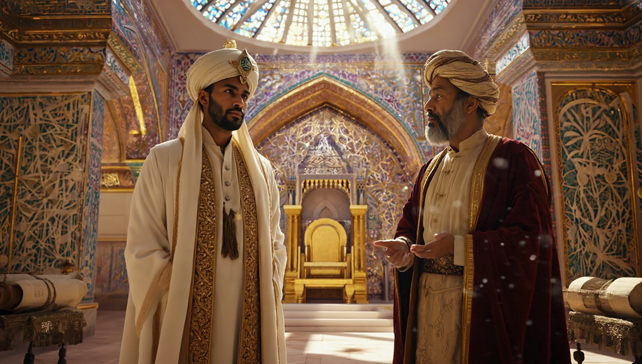
Caliph Al-Ma’mun, impressed by reports of this mathematical breakthrough, summoned Al-Khwarizmi to demonstrate his methods. The scholar showed how algebra could solve complex Islamic inheritance problems that had previously required extensive guesswork.
Recognizing the revolutionary importance of this discovery, the Caliph commissioned Al-Khwarizmi to write a comprehensive book explaining his methods.
The Influential “Al-Kitab al-jabr wa’l-muqābalah”
Creating the First Algebra Textbook
Al-Khwarizmi’s masterwork, “Al-Kitab al-jabr wa’l-muqābalah” (The Book of Restoration and Completion), became one of history’s most influential mathematical texts. This comprehensive guide made algebraic methods accessible to any educated person.
Key Features of the Book:
- Systematic procedures for solving equations
- Practical applications to real-world problems
- Clear explanations accessible to non-mathematicians
- Geometric proofs supporting algebraic methods
Beyond Algebra: Al-Khwarizmi’s Other Contributions
Al-Khwarizmi’s genius extended far beyond algebra:
Geography: He created the most accurate world map of his time, correcting errors in Ptolemy’s ancient geography.
Astronomy: He used algebraic methods to predict celestial movements with unprecedented precision.
Number Systems: His book on Hindu-Arabic numerals introduced Europe to the decimal system we use today.
The Lasting Impact on World Mathematics
Medieval Europe Discovers Algebra
Three centuries after Al-Khwarizmi’s death, European scholars began translating his works from Arabic into Latin. His name became “Algoritmi,” giving us the word “algorithm.”
Robert of Chester’s 1145 translation began with “Dixit Algoritmi” (Thus spoke Al-Khwarizmi), introducing algebraic thinking to European mathematics.
Building Blocks of Modern Science
Al-Khwarizmi’s algebraic methods became foundational to:
- Fibonacci’s number sequences
- Galileo’s descriptions of planetary motion
- Newton’s development of calculus
- Modern computer science and programming
Algebra in the Digital Age
From Ancient Baghdad to Modern Algorithms
Today, every computer runs on algorithms – systematic procedures for solving problems that trace directly back to Al-Khwarizmi’s original methods. His influence appears in:
GPS Navigation: Algebraic calculations determine your precise location and optimal routes.
Online Security: Cryptographic algorithms protect your digital transactions and personal data.
Search Engines: Complex algebraic formulas rank and retrieve information from billions of web pages.
Artificial Intelligence: Machine learning algorithms use algebraic principles to recognize patterns and make predictions.
The Continuing Revolution
Modern applications of Al-Khwarizmi’s algebraic thinking include:
- Weather forecasting models
- Financial market analysis
- Medical diagnostic systems
- Engineering design calculations
- Social media recommendation algorithms
Practical Applications: Understanding Algebra Today
Why Algebra Matters in Everyday Life
Budget Planning: Algebraic thinking helps you calculate loan payments, investment returns, and savings goals.
Home Improvement: Determining material quantities, calculating costs, and optimizing spaces all use algebraic principles.
Business Operations: Profit calculations, inventory management, and pricing strategies rely on algebraic methods.
Technology Use: Understanding how algorithms work helps you make better decisions about privacy, security, and digital tools.
Learning from Al-Khwarizmi’s Approach
Modern problem-solving can benefit from Al-Khwarizmi’s systematic methodology:
- Clearly define the unknown – What exactly are you trying to find?
- Identify relationships – How do known and unknown quantities connect?
- Apply systematic procedures – Follow logical steps rather than guessing
- Verify solutions – Check your answers against original conditions
- Document methods – Record successful approaches for future use
Frequently Asked Questions
Who was Al-Khwarizmi and why is he important?
Muhammad ibn Musa al-Khwarizmi (c. 780-850 CE) was a Persian mathematician, astronomer, and geographer who worked in Baghdad’s House of Wisdom. He’s considered the “Father of Algebra” for systematizing methods to solve equations with unknown quantities. His work laid the foundation for modern mathematics and computer science.
What does “al-jabr” mean and how did it become “algebra”?
“Al-jabr” comes from the Arabic phrase “al-jabr wa’l-muqābalah,” meaning “restoration and completion.” This described Al-Khwarizmi’s method of moving terms between sides of equations to solve for unknowns. When his works were translated into Latin, “al-jabr” became “algebra.”
How did Al-Khwarizmi’s work influence modern technology?
Al-Khwarizmi’s systematic approach to problem-solving created the foundation for algorithms – step-by-step procedures for solving problems. Every computer program, GPS system, search engine, and digital application uses algorithmic thinking that traces back to his original methods.
What was the House of Wisdom and why was it important?
The House of Wisdom in Baghdad (8th-13th centuries) was a major intellectual center during the Islamic Golden Age. It functioned as a library, translation center, and research institute where scholars from different cultures collaborated. This environment was crucial for Al-Khwarizmi’s mathematical innovations.
Can you give a simple example of Al-Khwarizmi’s algebraic method?
Consider the problem: “A number plus 5 equals 12. What is the number?” Al-Khwarizmi would write this as an equation (x + 5 = 12), then systematically solve it by subtracting 5 from both sides to get x = 7. This systematic approach was revolutionary for its time.
Why is Al-Khwarizmi called the “Father of Algebra”?
While earlier mathematicians worked with unknown quantities, Al-Khwarizmi was the first to create a systematic, comprehensive method for solving algebraic problems. His book “Al-Kitab al-jabr wa’l-muqābalah” established algebra as a distinct branch of mathematics with clear rules and procedures.
The Enduring Legacy of Mathematical Innovation
Al-Khwarizmi’s revolutionary discovery in that candlelit Baghdad study continues to shape our world more than 1,200 years later. His systematic approach to solving problems with unknown quantities didn’t just create algebra – it demonstrated that innovation comes from refusing to accept limitations and asking, “What if there’s another way?”
From the inheritance problems of 9th century Islamic law to the complex algorithms powering artificial intelligence, Al-Khwarizmi’s legacy reminds us that curiosity combined with systematic thinking can unlock solutions to seemingly impossible problems.
Ready to explore more mathematical history? Discover how other Islamic Golden Age scholars built upon Al-Khwarizmi’s work to create the mathematical foundations of our modern world. Share this article with fellow math enthusiasts and continue the tradition of mathematical curiosity that Al-Khwarizmi began.